
The Key Difference
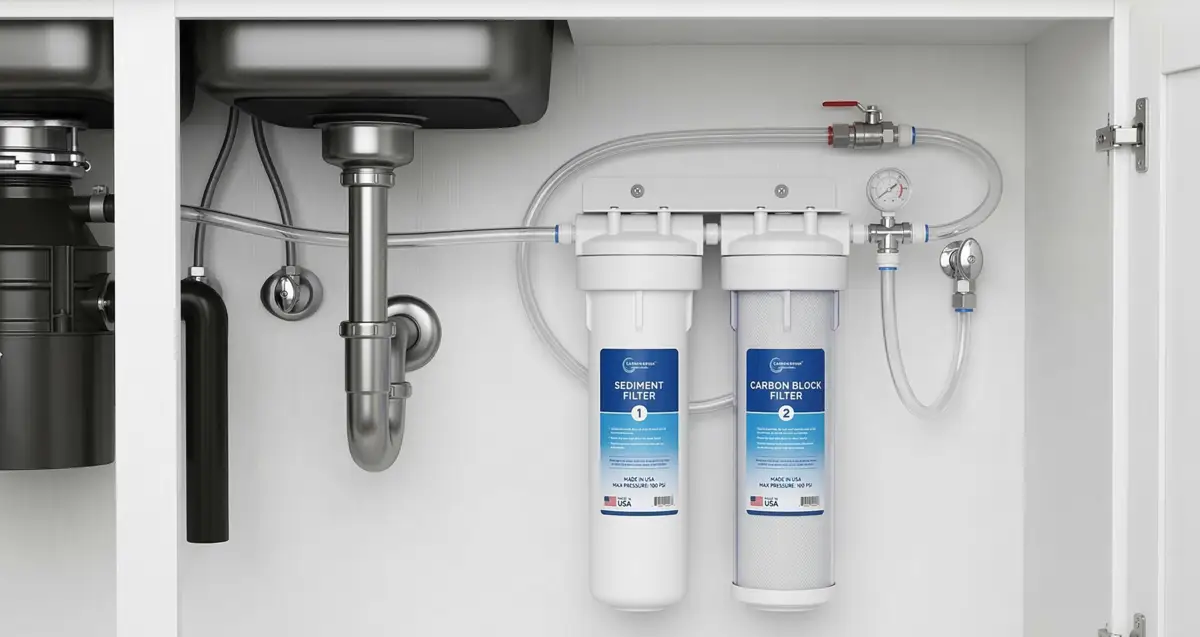
Water softeners and water filters solve fundamentally different problems. A softener removes hardness minerals (calcium and magnesium) that cause scale buildup and damage plumbing. A filter removes contaminants that affect health or taste — lead, chlorine, PFAS, bacteria, and others. Many homes need one or the other. Some homes need both.
Understanding the distinction prevents two common and expensive mistakes: buying a softener when you actually need a filter (your appliances are protected, but you’re still drinking contaminants), or buying a filter when you need a softener (your water tastes better, but scale is still destroying your water heater).
What Is Hard Water?
Hard water contains elevated concentrations of dissolved calcium and magnesium ions. These minerals dissolve naturally as groundwater percolates through limestone, dolomite, and gypsum formations. Hard water is not a health hazard — the EPA does not regulate water hardness, and calcium and magnesium are essential dietary minerals. The World Health Organization has noted that hard water may provide a meaningful share of daily calcium and magnesium intake.
But hard water causes significant household problems that cost money and reduce the lifespan of plumbing and appliances.
Hardness Scale
Water hardness is measured in grains per gallon (gpg) or milligrams per liter (mg/L) of calcium carbonate equivalent:
| Grains per Gallon (gpg) | mg/L (ppm) | Classification |
|---|---|---|
| 0-3.5 | 0-60 | Soft |
| 3.5-7 | 60-120 | Moderately hard |
| 7-10.5 | 120-180 | Hard |
| 10.5+ | 180+ | Very hard |
About 85% of U.S. homes have moderately hard to very hard water. The hardest water is found in the Great Plains, Southwest, and Florida, where groundwater contacts mineral-rich geologic formations. Parts of Texas, Arizona, Indiana, and Wisconsin regularly exceed 15 gpg.
Check your city’s water data on WaterVerge to see reported hardness levels for your area.
Signs You Have Hard Water
You don’t need a lab test to suspect hard water — the symptoms are visible throughout your home:
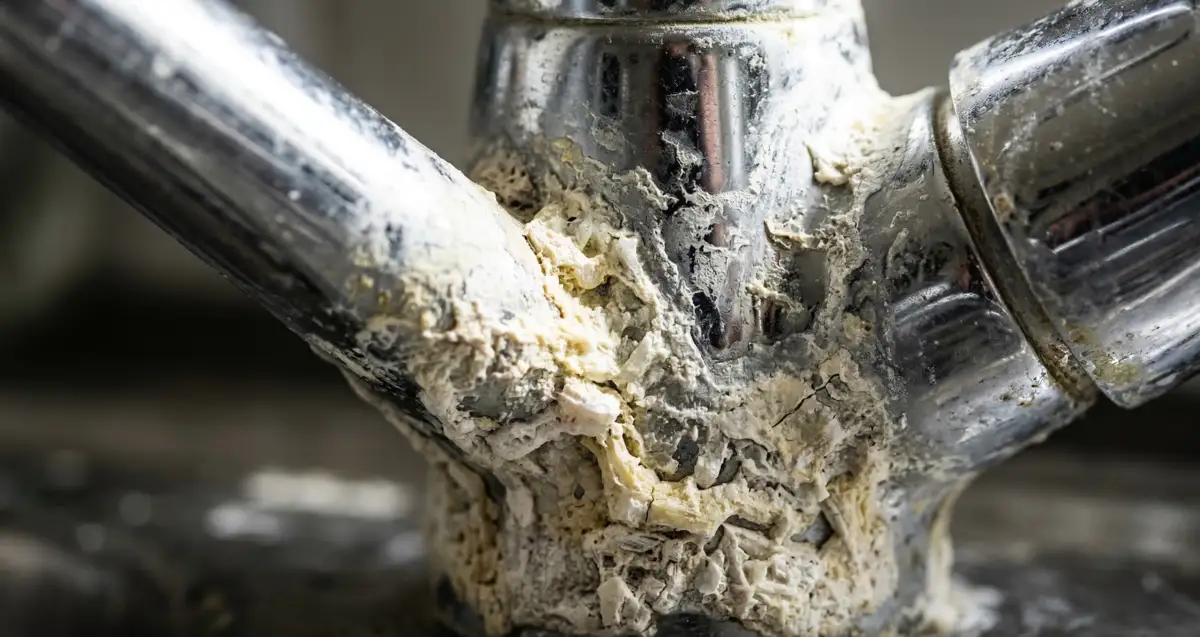
- White, chalky deposits (scale) on faucets, showerheads, kettles, and coffee makers. This is precipitated calcium carbonate and it builds up quickly in hard water areas.
- Soap that won’t lather well. Calcium ions react with soap to form an insoluble scum instead of suds. This leaves a filmy residue on skin, hair, and bathtub surfaces.
- Stiff, dingy laundry. Hard water reduces detergent effectiveness. Minerals bind to fabric fibers, making clothes feel rough and look dull even with extra detergent.
- Spots on dishes and glassware. After the dishwasher finishes, mineral deposits leave cloudy white spots that don’t wipe clean.
- Reduced appliance lifespan. Scale buildup insulates heating elements in water heaters, dishwashers, and washing machines, forcing them to work harder and fail sooner. The Water Quality Research Foundation estimates that hard water can reduce water heater efficiency by up to 48% and cut appliance lifespan by 30-50%.
- Reduced water flow. Over years, scale narrows pipe interiors, particularly in hot water lines. Showerheads and aerators clog faster.
How Water Softeners Work
Ion Exchange (Salt-Based) — Traditional Method
The most common and most effective residential softener. Here’s the process:
- Hard water enters a resin tank filled with thousands of small polystyrene beads, each carrying a sodium (Na+) or potassium (K+) charge.
- As water flows through the bed, calcium (Ca²+) and magnesium (Mg²+) ions are attracted to the resin beads and swap places with the sodium ions. Two sodium ions are released for every calcium or magnesium ion captured.
- The result is soft water with slightly elevated sodium content. For most people, the added sodium is negligible — roughly 12.5 mg per 8-ounce glass at 10 gpg hardness (compared to 150+ mg in a slice of bread). People on strict sodium-restricted diets can use potassium chloride pellets instead.
- Periodically (typically every 2-7 days depending on water use and hardness), the system regenerates. A brine solution (salt dissolved in water) flushes through the resin bed, stripping off the captured calcium and magnesium and recharging the beads with fresh sodium ions. The brine and captured minerals are flushed to drain.
Maintenance: Add salt to the brine tank every 4-8 weeks. A 40-pound bag costs $5-$10. Replace resin every 10-15 years. Annual cost: $60-$120.
Waste: Each regeneration cycle uses 25-65 gallons of water. Some municipalities restrict brine discharge — check local regulations.
Salt-Free Conditioners (TAC/NAC)
These systems don’t technically “soften” water — they condition it using Template Assisted Crystallization (TAC) or Nucleation Assisted Crystallization (NAC). The process converts dissolved calcium and magnesium into microscopic crystalline particles that pass through plumbing without adhering to surfaces.
What they do well: Reduce scale formation in pipes and on heating elements. No salt, no wastewater, no electricity, minimal maintenance.
What they don’t do: They don’t reduce measured hardness (your water’s gpg stays the same). They don’t improve soap lathering. They don’t eliminate spots on dishes or the filmy feeling on skin and hair. They’re also less effective at hardness levels above 25 gpg.
Salt-free conditioners are a reasonable choice if your primary concern is protecting appliances and you don’t mind the other hard water symptoms. For complete hardness removal, ion exchange is the standard.
How Water Filters Work
Water filters use physical barriers, chemical processes, or a combination to remove specific contaminants from water. Unlike softeners (which only address minerals), filters target health-affecting and taste-affecting substances.
Activated Carbon
The most common filter media. Carbon adsorbs (traps on its surface) chlorine, volatile organic compounds (VOCs), some pesticides, and disinfection byproducts. It’s the primary technology in pitcher filters, faucet-mount filters, and refrigerator filters. Effective for taste and odor improvement. Does not remove dissolved metals, nitrate, or PFAS (unless specifically designed and certified for PFAS).
Reverse Osmosis (RO)
The broadest-spectrum home filtration technology. RO forces water through a semipermeable membrane with pores small enough to block dissolved solids, metals, PFAS, arsenic, nitrate, fluoride, and most microorganisms. Typical residential RO systems remove 95-99% of total dissolved solids.
RO systems are installed under the sink and serve a single faucet. They produce 2-4 gallons of waste water per gallon of filtered water. Whole-house RO systems exist but are expensive ($3,000-$10,000+) and uncommon.
KDF (Kinetic Degradation Fluxion)
A copper-zinc alloy media that removes chlorine, heavy metals (lead, mercury, iron), and hydrogen sulfide through an electrochemical oxidation-reduction process. Often used in shower filters and as a pre-treatment stage in whole-house systems.
Ceramic Filters
Porous ceramic elements with sub-micron pore sizes block bacteria, parasites, sediment, and turbidity. Commonly used in gravity-fed systems and in developing countries for point-of-use treatment. Not effective against dissolved chemicals or viruses.
UV Disinfection
Ultraviolet light at 254 nanometers destroys the DNA of bacteria, viruses, and parasites, rendering them unable to reproduce. UV is chemical-free and doesn’t alter taste. It’s the standard treatment for well water bacteria. UV does not remove chemicals, metals, or sediment — it only addresses microbiological contamination.
Side-by-Side Comparison
| Feature | Water Softener | Water Filter |
|---|---|---|
| Purpose | Removes hardness minerals (Ca, Mg) | Removes contaminants (lead, chlorine, PFAS, etc.) |
| What it removes | Calcium, magnesium | Varies by type — see above |
| What it doesn’t remove | Contaminants, bacteria, chemicals | Hardness minerals (except RO) |
| Installation | Whole-house (point of entry) | Whole-house, under-sink, or countertop |
| Equipment cost | $800-$2,500 (ion exchange) | $25-$400 (pitcher to under-sink RO) |
| Annual maintenance | $60-$120 (salt) | $50-$200 (replacement filters) |
| Health benefit | Indirect (protects plumbing from lead leaching) | Direct (removes health-affecting contaminants) |
| Typical lifespan | 15-20 years | 2-15 years depending on type |
When You Need a Softener
Install a water softener if:
- Your water hardness exceeds 7 gpg (hard)
- You’re seeing scale buildup on fixtures and in appliances
- Your water heater efficiency has declined or you’re replacing appliances prematurely
- You want better soap lathering, softer laundry, and spot-free dishes
- Your home is on municipal water with contaminant levels that meet your comfort level (no additional filtration needed)
A softener alone makes sense when your water quality is already good from a health standpoint — meaning contaminant levels are below MCLGs and you have no concerns about lead, PFAS, or other specific substances. Check your city on WaterVerge to see contaminant data and violation history before deciding.
When You Need a Filter
Install a water filter if:
- Your water contains detected contaminants above levels you’re comfortable with — lead, PFAS, arsenic, disinfection byproducts, or others
- Your home was built before 1986 (likely has lead solder) or has a lead service line
- You want to reduce chlorine taste and odor
- You’re on a private well with bacteria, nitrate, or other contamination risks
- Your water system has a history of violations (check on WaterVerge)
For drinking water quality concerns, a point-of-use filter (under-sink RO or certified pitcher) is usually sufficient and far more cost-effective than a whole-house filtration system. See our filter pitcher guide for recommendations.
When You Need Both
The most common scenario requiring both a softener and a filter:
Hard Water + Contaminants
If your water is hard (7+ gpg) and also contains contaminants like lead, PFAS, or elevated disinfection byproducts, the right setup combines both technologies:
- Whole-house softener — installed where water enters the home, before the water heater. This protects all plumbing, appliances, and fixtures from scale.
- Point-of-use filter — installed at the kitchen sink for drinking and cooking water. An under-sink RO system or NSF-certified faucet filter removes health-affecting contaminants at the tap where you consume water.
This two-stage approach is the most cost-effective and practical solution for most homes. The softener handles the whole house, and the drinking water filter handles the health-critical tap.
Well Water
Private wells frequently have both hard water and contamination concerns (bacteria, iron, nitrate). A typical well water treatment train might include:
- Sediment pre-filter
- Water softener (for hardness and iron)
- UV disinfection (for bacteria)
- Under-sink RO (for drinking water)
See our well water testing guide for details on identifying what’s in your well.
Important Note
Install the softener before the filter in the water flow path. Softened water extends filter life by preventing mineral buildup on filter media. An RO membrane in particular lasts significantly longer when processing softened water.
Cost Comparison
Water Softener (Ion Exchange)
- Equipment + installation: $800-$2,500 (varies by capacity and installer)
- Annual maintenance: $60-$120 (salt only; $200-$300 if using potassium chloride)
- Lifespan: 15-20 years
- Total 10-year cost: ~$1,400-$3,700
Salt-Free Conditioner
- Equipment + installation: $500-$1,500
- Annual maintenance: Near zero (no consumables)
- Lifespan: 10-15 years (media may need replacement)
- Total 10-year cost: ~$500-$1,500
Under-Sink Reverse Osmosis
- Equipment + installation: $150-$500 (many are DIY-installable)
- Annual maintenance: $50-$80 (membrane every 2-3 years, pre/post filters every 6-12 months)
- Lifespan: 10-15 years
- Total 10-year cost: ~$650-$1,300
Whole-House Carbon Filter
- Equipment + installation: $300-$1,500
- Annual maintenance: $100-$200 (media or cartridge replacement)
- Lifespan: Ongoing (with media replacement)
- Total 10-year cost: ~$1,300-$3,500
Pitcher Filter
- Equipment: $25-$90
- Annual maintenance: $50-$100 (replacement cartridges)
- Lifespan: 2-5 years (pitcher body)
- Total 10-year cost: ~$550-$1,100 (including pitcher replacements)
How to Decide
Start by understanding your water. Don’t buy treatment equipment based on marketing or fear — base your decision on actual data about what’s in your water.
Step 1: Check Your Water Quality
Search your city on WaterVerge to see contaminant detections, violation history, lead levels, and PFAS data. If you’re on a well, get a comprehensive test from a certified lab (see our well water testing guide).
Step 2: Test Your Hardness
If you’re on municipal water, your utility’s CCR or WaterVerge should report hardness. If you’re on a well, a $10 test strip kit from a hardware store gives a quick reading. For a precise number, include hardness in your next lab panel.
Step 3: Match Treatment to Problem
- Hardness only (no contaminant concerns) → Water softener
- Contaminants only (soft or moderate water) → Point-of-use filter (pitcher, faucet-mount, or under-sink RO)
- Both hard water and contaminants → Whole-house softener + point-of-use drinking water filter
- Well water → Test first, then build a treatment train based on results
Step 4: Size Correctly
Softeners are sized by grain capacity — multiply your hardness (gpg) by daily water use (gallons) by days between regenerations. Filters are sized by flow rate (GPM) for whole-house or capacity (gallons) for point-of-use. Oversizing wastes money. Undersizing reduces effectiveness and shortens equipment life.
The right amount of treatment is the minimum needed to address your actual water quality issues. A $40 NSF 53-certified pitcher filter that removes lead is a better investment than a $2,000 whole-house system that doesn’t target your specific contaminant.
Check your water quality
See what contaminants are in your city's tap water and get personalized filter recommendations.