
Why Well Water Testing Matters
Approximately 43 million Americans — about 13% of the U.S. population — rely on private wells for their drinking water. Unlike the 50,000+ public water systems regulated by the EPA, private wells operate entirely outside federal oversight. No government agency tests your well water, treats it, or sends you an annual quality report. There are no enforceable federal standards for private wells.
That responsibility falls entirely on you, the well owner.
This isn’t just a technicality. Private wells are vulnerable to contamination from dozens of sources: agricultural runoff, septic system failures, naturally occurring minerals like arsenic and radon, industrial chemicals including PFAS, and bacterial intrusion from surface water. A well that tested clean five years ago can become contaminated by new development, changing groundwater patterns, or gradual leaching that only reaches detectable levels over time.
The CDC estimates that over 4 million cases of illness per year in the United States are attributed to private well water. Contamination is often invisible — you can’t see, smell, or taste most dangerous contaminants, including arsenic, nitrate, lead, and PFAS. Regular, lab-certified testing is the only way to know what’s in your water.
Minimum Annual Tests
The CDC and EPA recommend testing your well at least once per year for three core parameters. Together, these provide a baseline assessment of your well’s safety.
Total Coliform Bacteria
Coliform bacteria are a group of organisms commonly found in soil, surface water, and animal waste. Their presence in well water indicates that surface contamination is reaching your well — through cracks in the casing, a damaged well cap, surface runoff, or a nearby failing septic system.
A positive total coliform result doesn’t necessarily mean your water is making you sick, but it triggers a mandatory follow-up test for E. coli. E. coli in well water signals fecal contamination and an immediate health risk — stop drinking the water until you’ve disinfected the well and confirmed the issue is resolved.
Cost: $15-$30 per test
Nitrate
Nitrate is the most common chemical contaminant in private wells. It comes from fertilizer application, animal waste, septic system leachate, and decaying organic matter. The EPA’s maximum contaminant level for public systems is 10 mg/L (milligrams per liter). While this limit doesn’t technically apply to private wells, it’s the benchmark labs use for comparison.
Nitrate above 10 mg/L is dangerous for infants under 6 months. It interferes with the blood’s ability to carry oxygen, causing methemoglobinemia — commonly known as “blue baby syndrome.” Adults can tolerate higher levels, but chronic exposure above 10 mg/L has been linked to thyroid problems and increased cancer risk in some studies.
Cost: $15-$25 per test
pH Level
Water pH measures acidity (below 7) or alkalinity (above 7). The ideal range for drinking water is 6.5-8.5. Well water with pH below 6.5 is corrosive and can leach metals — including lead and copper — from plumbing pipes, fittings, and fixtures. Water with pH above 8.5 can cause scaling, reduce the effectiveness of disinfection, and create a bitter taste.
pH also affects the performance of treatment systems. If your pH is outside the normal range, it should be corrected before installing other filtration.
Cost: $10-$15 (often bundled with other tests)
Additional Tests Based on Location
Beyond the annual basics, certain contaminants should be tested based on your geography, geology, and surrounding land use.
Arsenic
Where: Western U.S. (especially Arizona, Nevada, California), New England (New Hampshire, Maine), Upper Midwest (Wisconsin, Minnesota). Arsenic occurs naturally in bedrock and dissolves into groundwater. Over 2 million private wells in the U.S. are estimated to exceed the EPA’s 10 ppb guideline.
How often: Every 3-5 years, or immediately if you’re in a known high-arsenic area and have never tested.
Cost: $20-$35
Radon
Where: Northeast (particularly Pennsylvania, New Jersey, New York), Appalachian region, and areas with granite bedrock. Radon is a naturally occurring radioactive gas that dissolves in groundwater and is released into indoor air during showering, dishwashing, and other water use. The EPA estimates that radon in water causes about 168 cancer deaths per year in the U.S.
How often: Every 3-5 years.
Cost: $25-$40
PFAS
Where: Within 5 miles of military bases, airports (where AFFF firefighting foam was used), industrial facilities, or landfills. Also a concern near wastewater treatment plant discharge points.
How often: Once to establish a baseline, then every 3-5 years. Immediately if contamination is reported in your area.
Cost: $150-$300 for a full PFAS panel (EPA Method 533 or 537.1)
For more on PFAS, see our PFAS guide and the private wells and PFAS guide.
Pesticides and Herbicides
Where: Near active agricultural land, orchards, or areas with heavy herbicide application (including golf courses). Atrazine, glyphosate, and organophosphates are the most commonly detected.
How often: During or immediately after the growing season.
Cost: $75-$150
Volatile Organic Compounds (VOCs)
Where: Near gas stations, dry cleaners, auto repair shops, industrial facilities, or former manufacturing sites. VOCs include benzene, toluene, TCE (trichloroethylene), and PCE (perchloroethylene).
How often: Once to establish baseline, then every 3-5 years.
Cost: $80-$150
Heavy Metals
Where: Homes with older plumbing, areas with mining history, or regions with naturally occurring metal-rich geology. Test for lead, copper, manganese, and iron — and in the western US, also uranium, vanadium, and molybdenum.
How often: Every 3-5 years, or if you notice metallic taste, staining, or discoloration.
Cost: $20-$40 per metal
When to Test Beyond the Schedule
Certain events and changes should trigger immediate testing, regardless of your regular schedule:
- New well construction: Test before first use and again 2-3 months after to confirm consistent results
- After flooding: Floodwater can introduce bacteria, chemicals, and sediment directly into the well
- Changes in taste, odor, or color: Any perceptible change warrants testing — these can indicate bacterial contamination, chemical intrusion, or changes in well integrity
- Nearby land use changes: New construction, agricultural expansion, septic system installation within 100 feet, or industrial activity
- Infant in household: Test for nitrate and bacteria before a baby arrives or begins using well water for formula
- Real estate transaction: Both buyers and sellers should test the well. Many mortgage lenders require well water testing as a condition of financing. A comprehensive test protects both parties.
- Unexplained illness: Gastrointestinal symptoms (nausea, diarrhea, cramps) without another clear cause should prompt bacteria and nitrate testing
How to Collect a Proper Sample
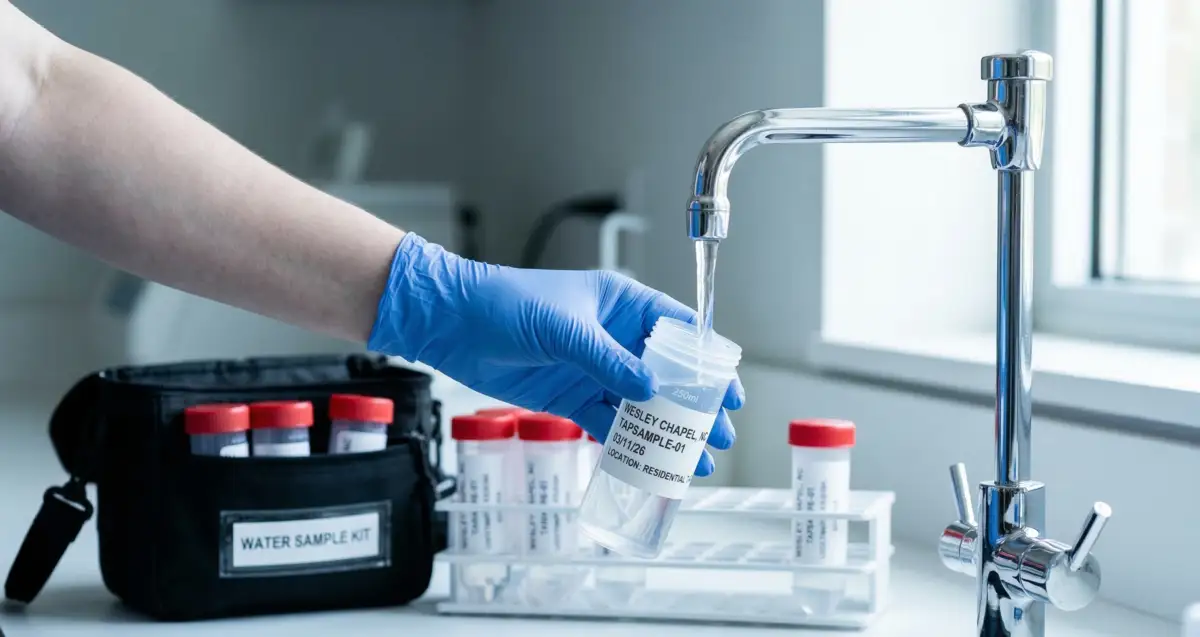
Accurate results depend entirely on proper sample collection. Contamination introduced during sampling is the most common cause of false positive bacteria results.
Step-by-Step Collection
-
Use the lab’s containers. Never use your own bottles. Labs provide sterile, preservative-treated containers specific to each test. Some preservatives are required for accurate chemical analysis. Using the wrong container can invalidate results.
-
Remove the faucet aerator. Unscrew the aerator from the faucet tip and set it aside. Aerators can harbor bacteria and sediment that would contaminate the sample.
-
Sterilize the faucet. Clean the faucet opening with rubbing alcohol or a flame (hold a lighter to the metal tip for 5-10 seconds). Let it cool before collecting.
-
Run cold water for 3-5 minutes. This clears standing water in the home’s plumbing and draws fresh water directly from the well. For bacteria samples, you want well water — not water that’s been sitting in pipes.
-
Fill containers to the indicated line. Don’t overfill or underfill. For bacteria samples, leave a small air space to allow the lab to mix the sample. For chemical samples, fill completely to prevent air oxidation.
-
Keep samples cold. Pack them with ice packs in an insulated bag or cooler. Bacteria samples must remain below 10°C (50°F) and reach the lab within 24-30 hours. Chemical samples are more stable but still benefit from cold storage.
-
Avoid contamination. Don’t smoke, eat, or apply hand sanitizer while handling bacteria sample bottles. Don’t touch the inside of caps or bottle openings. Don’t set containers on the ground.
-
Label everything. Include your name, address, date, time of collection, and sample location (e.g., “kitchen cold tap”).
Finding a Certified Lab
Not all laboratories are equal. For drinking water testing, use a lab that holds certification from your state’s drinking water program or the EPA.
State Health Department Labs
Many state and county health departments operate drinking water labs or coordinate testing programs. These often provide the lowest cost for basic tests (bacteria, nitrate, pH). Some offer free bacteria testing. Contact your county health department or search your state’s environmental agency website.
State University Extension Programs
Cooperative extension offices in many states coordinate annual well water testing events. These “well water clinics” or “screening programs” offer group rates — typically $25-$75 for a comprehensive basic panel. Check your state’s land-grant university extension website.
Online Lab Services
National services ship collection kits to your door and handle logistics:
- Tap Score (SimpleLab): Comprehensive well water panels starting at ~$200. Recommended by Wirecutter. Uses certified labs and provides detailed, easy-to-read reports with specific treatment recommendations.
- National Testing Laboratories: Well water packages from ~$150-$650 depending on the number of contaminants tested.
- Eurofins Scientific: Full PFAS panel available (~$200-$300). The gold standard for PFAS-specific testing.
Verification
Always confirm the lab holds current certification from your state’s drinking water program. Ask for the lab’s certification number and verify it on your state’s website. Certified labs must follow EPA-approved analytical methods and participate in proficiency testing.
Interpreting Your Results
Your lab report will list each tested parameter alongside a detected value and a reference level. Since there are no enforceable federal limits for private wells, labs compare results against EPA MCLs (designed for public systems) and health advisory levels. Use these as your benchmark.
Results Comparison Table
| Contaminant | EPA Guideline | What It Means If Exceeded |
|---|---|---|
| Total coliform | Absent | Surface contamination reaching well. Shock-chlorinate, retest in 2 weeks. Inspect well cap and casing. |
| E. coli | Absent | Fecal contamination. Stop drinking immediately. Disinfect well. Investigate source (septic, animal waste). |
| Nitrate | 10 mg/L | Dangerous for infants. Use alternative water for formula. Identify source (fertilizer, septic). |
| Arsenic | 10 ppb | Long-term cancer risk. Install RO or adsorptive media filter. |
| Lead | 15 ppb | Replace plumbing source. Install NSF 53 filter at drinking water tap. |
| pH | 6.5-8.5 | Low pH: install acid neutralizer (calcite or soda ash). High pH: consult well professional. |
| Iron | 0.3 mg/L | Not a health risk but causes staining, taste issues. Install oxidation filter. |
| Manganese | 0.05 mg/L | Black staining, potential neurological effects at high levels. Install oxidation filter. |
| Radon | 4,000 pCi/L (proposed) | Install aeration system or GAC filter. Test indoor air radon too. |
| Hardness | No limit | Not a health risk. Install softener if above 7 gpg to protect plumbing and appliances. |
Understanding “Non-Detect”
If a result shows “ND” (non-detect) or ”< [number],” it means the contaminant was below the lab’s detection limit — the lowest concentration the method can reliably measure. Non-detect is the best possible result. Note that “non-detect” doesn’t mean “zero” — it means “below our ability to measure.”
Confirming Results
If any result exceeds guidelines, retest before investing in treatment. A single high reading can result from sampling error, a contaminated collection bottle, or a temporary spike. A confirmed exceedance on a second sample is a stronger basis for action.
Treatment Options by Contaminant
Once you know what’s in your water, match the treatment technology to the specific problem:
| Contaminant | Recommended Treatment | Typical Cost |
|---|---|---|
| Bacteria (coliform, E. coli) | UV disinfection or continuous chlorination | $500-$1,500 |
| Nitrate | Reverse osmosis or ion exchange | $150-$400 (POU RO) |
| Arsenic | Adsorptive media (iron-based) or RO | $500-$2,000 |
| Radon | Aeration system (spray or bubble) | $1,500-$4,000 |
| Iron / Manganese | Oxidation filter (birm, greensand, AIO) | $800-$2,500 |
| Hardness | Ion exchange water softener | $800-$2,500 |
| PFAS | Reverse osmosis or granular activated carbon | $150-$400 (POU RO) |
| VOCs | Granular activated carbon | $300-$1,500 |
| Low pH | Acid neutralizer (calcite/corosex) | $500-$1,500 |
For homes with multiple contaminants (common in wells), treatment systems are installed in series. A typical setup for a well with hard water, iron, and bacteria might be: sediment filter → softener → UV disinfection → under-sink RO for drinking water. See the best reverse osmosis systems and best whole-house water filters for tested options, and softeners vs filters if you’re choosing between them.
Maintaining Your Well
Regular maintenance prevents contamination and extends well life:
Annual Inspection
Have a licensed well contractor inspect your well annually. They’ll check:
- Well cap and seal integrity (cracked caps allow surface water and insects in)
- Casing condition (corrosion or cracks in the steel or PVC casing)
- Electrical connections and pressure switch
- Pressure tank operation
- Flow rate (declining flow may indicate pump issues or aquifer changes)
Wellhead Protection
The area around your wellhead is your first line of defense:
- Maintain a minimum 50-foot separation between the well and any septic system, fuel tank, or chemical storage
- Keep the wellhead at least 12 inches above grade to prevent surface water from pooling around it
- Don’t store chemicals, fertilizers, or fuel near the well
- Divert surface water drainage away from the wellhead
- Don’t stack snow, leaves, or debris around the well casing
Record Keeping
Maintain a file with:
- Well construction report (depth, casing diameter, yield, static water level)
- All lab test results with dates
- Maintenance and repair records
- Treatment system installation and filter replacement logs
Over time, your records reveal trends. Slowly rising nitrate may indicate a deteriorating septic system. Seasonal bacteria spikes may point to surface water intrusion during spring thaw or heavy rain. Declining yield may signal aquifer depletion or pump wear.
Frequently Asked Questions
How much does well water testing cost?
A basic annual panel (bacteria, nitrate, pH) costs $40-$75 through a state lab or extension program. A comprehensive panel adding arsenic, heavy metals, VOCs, and hardness runs $150-$300. PFAS testing adds $150-$300. The most thorough testing available (100+ parameters) costs $500-$650 through services like National Testing Laboratories.
Can I test my well water at home with a kit from the hardware store?
Home test strips and DIY kits ($15-$30) provide a rough screening but are not substitutes for certified lab analysis. They can give false negatives (missing contamination) or false positives (causing unnecessary alarm). For any health-related decision — especially bacteria, nitrate, lead, or arsenic — use a certified lab.
My well water smells like rotten eggs. Is it dangerous?
The smell is almost always hydrogen sulfide gas, which is produced by sulfate-reducing bacteria in the well or aquifer. At concentrations found in most wells, it’s unpleasant but not dangerous. Treatment options include aeration, chlorination, or an oxidation filter. However, test the water to rule out other issues — the smell can sometimes mask other contamination.
How often should I shock-chlorinate my well?
Shock chlorination (pouring a bleach solution into the well to kill bacteria) should be done when bacteria are detected, after well repairs, after flooding, or when the well is newly drilled. It is not a substitute for regular testing and should not be done routinely without cause — repeated chlorination can damage well components and kill beneficial bacteria in the aquifer that help break down naturally occurring iron and manganese.
Check your water quality
See what contaminants are in your city's tap water and get personalized filter recommendations.