
Why Filter Your Tap Water?
The EPA regulates over 90 contaminants in public drinking water, but “regulated” doesn’t mean “absent.” According to EPA compliance data, thousands of water systems report detectable levels of lead, disinfection byproducts, nitrates, and other substances — sometimes at levels that are legal but above the non-enforceable health goals (MCLGs) set by the agency.
Then there are contaminants the EPA is only beginning to address. PFAS “forever chemicals” have been found in an estimated 45% of U.S. tap water samples, according to a 2023 United States Geological Survey study. The EPA’s first-ever PFAS drinking water standard, finalized in April 2024, won’t require full compliance until 2029 at the earliest.
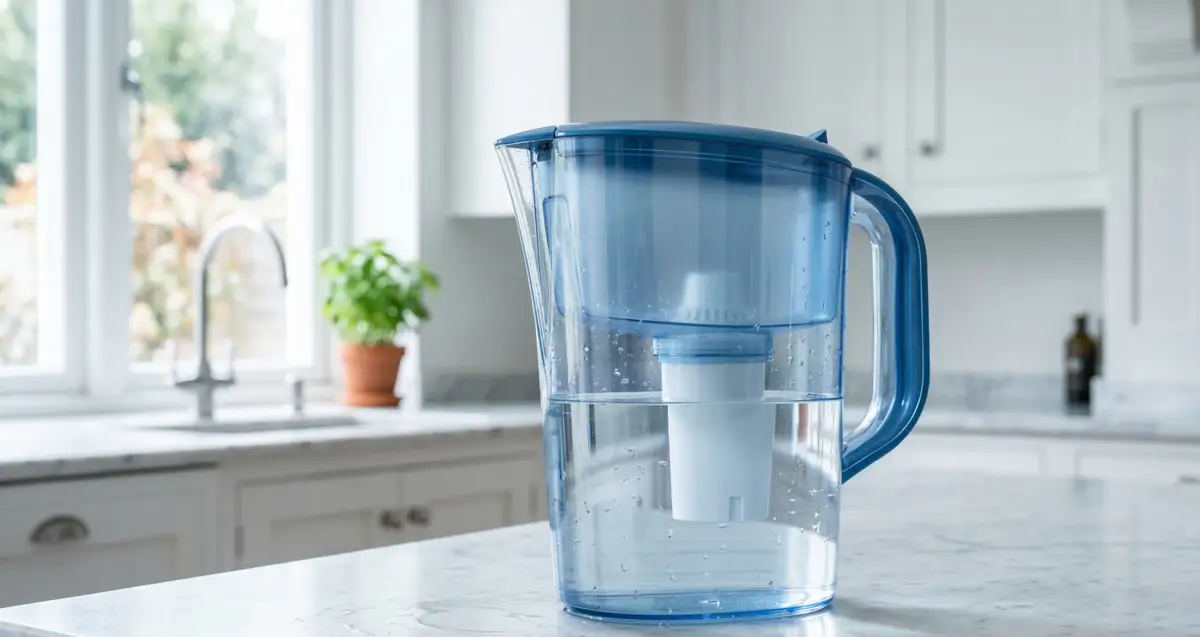
A water filter pitcher is the simplest entry point for cleaner drinking water. No plumbing modifications, no installation — just fill the reservoir and pour. Prices range from $20 to $100, and replacement filters cost $30 to $90 per year. For renters, apartment dwellers, or anyone who wants better water without committing to an under-sink system, a certified pitcher is the most practical first step.
But not all pitchers are equal. A basic carbon filter improves taste; a certified multi-stage filter can reduce lead by 99% and cut PFAS to non-detect levels. The difference comes down to certifications, filter media, and independent testing.
How Pitcher Filters Work
All pitcher filters use gravity — water drains from an upper reservoir through a filter cartridge into a lower pitcher. What varies is the filtration media inside the cartridge.
Activated Carbon
The most common filter media. Granular activated carbon (GAC) or carbon block adsorbs chlorine, volatile organic compounds (VOCs), and some pesticides. Carbon is excellent for taste and odor but limited against dissolved metals and PFAS without additional media.
Ion Exchange Resin
Small resin beads swap harmful ions (like lead or mercury) for harmless ones (like sodium or potassium). Ion exchange is the primary mechanism for lead reduction in most certified pitchers. It’s also used in some PFAS-targeting filters.
Mechanical Filtration
Some pitchers include sub-micron mesh or membrane layers that physically block sediment, cysts (like Giardia and Cryptosporidium), and particulate matter. LifeStraw’s membrane microfilter is one example, offering bacteria removal not found in standard carbon pitchers.
Multi-Stage Systems
Premium pitchers like Clearly Filtered and ZeroWater combine multiple media types in a single cartridge — carbon, ion exchange, and sometimes proprietary composites. These multi-stage designs target the broadest range of contaminants but tend to filter more slowly and cost more per cartridge.
NSF Certifications Explained
NSF International (now NSF) certifications are the gold standard for water filter claims. When a filter is “NSF certified,” an independent lab has verified that it actually removes what the manufacturer claims, under standardized test conditions. Here’s what each certification covers:
- NSF/ANSI 42 — Aesthetic Effects: Reduces chlorine taste and odor, particulates, and sediment. The baseline certification for any filter. If a pitcher only has NSF 42, it improves taste but provides minimal health protection.
- NSF/ANSI 53 — Health Effects: Reduces specific health-related contaminants including lead, mercury, asbestos, VOCs, and cysts (Giardia, Cryptosporidium). This is the certification to look for if you’re concerned about lead in your home’s water.
- NSF/ANSI 401 — Emerging Compounds: Reduces trace-level emerging contaminants such as pharmaceuticals (ibuprofen, estrone), herbicides, and pesticides. A newer standard that addresses chemicals not yet federally regulated.
- NSF/ANSI P473 — PFOA and PFOS: Specifically tests for reduction of two key PFAS compounds. Any filter claiming PFAS removal should carry this certification or provide independent lab testing to the same standard.
- NSF/ANSI 58 — Reverse Osmosis: Covers RO systems (not applicable to gravity pitchers, but relevant for under-sink comparisons). Verifies TDS reduction, contaminant removal, and system efficiency.
A single pitcher can carry multiple certifications. The more certifications, the broader and more verified its contaminant removal. Always verify claims on NSF’s public database — some manufacturers overstate their certifications.
Our Top Picks
Best Overall: Clearly Filtered
Clearly Filtered’s pitcher uses a proprietary Affinity Filtration technology with three filtration stages. It is tested and certified to reduce over 365 contaminants — more than any other pitcher on the market. That includes lead (up to 99.5%), PFOA and PFOS (up to 99.9%), chromium-6, fluoride, microplastics, and dozens of pharmaceuticals.
- Certifications: NSF 42, 53, 401, P473
- Pitcher price: ~$90
- Filter cost: ~$35 per cartridge (2 per year = ~$70/year)
- Filter life: ~100 gallons / 4 months
- Best for: Households wanting the most comprehensive protection from a single pitcher
The main trade-off is speed — Clearly Filtered takes 15-20 minutes to filter a full pitcher, slower than simpler carbon filters. The pitcher holds about 10 cups.
Best Value: Brita Elite (formerly Longlast+)
The Brita Elite is the most widely available pitcher filter with meaningful contaminant reduction. It’s NSF certified for chlorine, lead, asbestos, benzene, and several PFAS-related compounds. At roughly $0.13 per gallon of filtered water, it offers the best cost-per-gallon ratio among certified pitchers.
- Certifications: NSF 42, 53, 401
- Pitcher price: ~$35
- Filter cost: ~$18 per cartridge (2-3 per year = ~$45/year)
- Filter life: ~120 gallons / 6 months
- Best for: Budget-conscious households who want certified lead and chlorine removal
Note: The standard Brita filter (white cartridge) only has NSF 42 — it does not meaningfully reduce lead or PFAS. Make sure you’re buying the Elite (blue cartridge).
Best for PFAS: Epic Pure
Epic Pure’s filter is independently tested by Eurofins Scientific and certified by IAPMO (a certifying body recognized by NSF standards). Its testing shows removal of PFOA, PFOS, GenX, and other PFAS compounds to below detection limits.
- Certifications: NSF 42, 53, 401 (IAPMO certified); independent PFAS testing
- Pitcher price: ~$40
- Filter cost: ~$25 per cartridge (3-4 per year = ~$80/year)
- Filter life: ~150 gallons / 3-4 months
- Best for: Households near military bases, airports, or industrial sites with known PFAS contamination
Epic’s filter also removes fluoride, chromium-6, and microplastics. The company publishes its full lab reports publicly, which is uncommon in the industry.
Best for Total Removal: ZeroWater
ZeroWater’s 5-stage filter is the only pitcher filter to achieve a 000 TDS (total dissolved solids) reading. It uses a combination of activated carbon, ion exchange, and a fine mesh distributor. The included TDS meter lets you monitor filter performance in real time — when the reading rises above 006, it’s time to replace the cartridge.
- Certifications: NSF 42, 53
- Pitcher price: ~$40
- Filter cost: ~$15 per cartridge (4-8 per year = ~$80-$120/year)
- Filter life: ~25-40 gallons (varies significantly by source water TDS)
- Best for: People who want the purest-tasting water or have very high TDS source water
The catch: ZeroWater filters deplete quickly in hard water areas. If your source water has high mineral content (TDS above 300), you may go through a filter every 2-3 weeks, making annual costs substantially higher than other options.
Best for Travel and Portability: LifeStraw Home
LifeStraw Home combines a membrane microfilter (0.2 microns) with activated carbon. The membrane stage removes 99.999% of bacteria and 99.99% of parasites — a claim no other pitcher filter can make. This makes it uniquely suitable for travel, camping, or areas with boil-water advisories.
- Certifications: NSF 42, 53, 401, P231 (microbiological)
- Pitcher price: ~$45
- Filter cost: Membrane lasts ~1 year; carbon filter ~$15 every 2 months
- Filter life: Membrane: ~264 gallons; Carbon: ~40 gallons
- Best for: Travelers, campers, or households during boil-water advisories
The membrane filter is reusable and lasts about a year. It does not remove TDS or PFAS, so pair it with a carbon filter (included) for broader protection.
Best Budget: PUR Plus
PUR Plus faucet-mount filters are popular, but their pitcher filters are also strong performers. The PUR Plus pitcher filter carries NSF 42 and 53 certifications, removes lead and mercury, and costs about half what premium options charge.
- Certifications: NSF 42, 53
- Pitcher price: ~$25
- Filter cost: ~$10 per cartridge (4-6 per year = ~$50/year)
- Filter life: ~40 gallons / 2 months
- Best for: Cost-sensitive households wanting basic certified lead and chlorine protection
PUR doesn’t target PFAS or emerging contaminants. If your city’s water quality report shows PFAS or pharmaceutical detections, consider upgrading to Clearly Filtered or Epic Pure.
Comparison Table
| Pitcher | Price | NSF Certs | Filter Life | Annual Filter Cost | Key Contaminants | Best For |
|---|---|---|---|---|---|---|
| Clearly Filtered | ~$90 | 42, 53, 401, P473 | 100 gal / 4 mo | ~$70 | 365+ including lead, PFAS, fluoride | Most comprehensive |
| Brita Elite | ~$35 | 42, 53, 401 | 120 gal / 6 mo | ~$45 | Lead, chlorine, asbestos, benzene | Best value |
| Epic Pure | ~$40 | 42, 53, 401 | 150 gal / 3-4 mo | ~$80 | PFAS, lead, fluoride, Cr-6 | PFAS removal |
| ZeroWater | ~$40 | 42, 53 | 25-40 gal | ~$80-120 | All TDS, lead, chromium | Purest taste |
| LifeStraw Home | ~$45 | 42, 53, 401, P231 | 264 gal (membrane) | ~$90 | Bacteria, parasites, lead | Travel / emergencies |
| PUR Plus | ~$25 | 42, 53 | 40 gal / 2 mo | ~$50 | Lead, mercury, chlorine | Budget protection |
Filter Replacement Guide
When to Replace
Every pitcher filter has a rated capacity in gallons and months. The cartridge should be replaced at whichever limit comes first. A household of four using about 1 gallon per day will exhaust a 40-gallon filter in roughly 40 days — well before the “2-month” guideline.
Signs Your Filter Is Worn Out
- Slower flow rate: Water takes noticeably longer to drain through the cartridge
- Return of chlorine taste or odor: The activated carbon is saturated
- TDS meter reading increases (ZeroWater): Direct measurement of filter exhaustion
- Filter indicator light (some Brita and PUR models): Electronic reminder based on time, not actual usage
Cost Per Gallon
A useful way to compare long-term value:
- Brita Elite: ~$0.13/gallon
- Clearly Filtered: ~$0.35/gallon
- Epic Pure: ~$0.17/gallon
- ZeroWater: ~$0.40-0.60/gallon (varies with source water)
- PUR Plus: ~$0.25/gallon
For context, bottled water costs $1.00-$2.00 per gallon. Even the most expensive pitcher filter is 70-90% cheaper than bottled water.
What to Check Before Buying
The right filter depends on what’s actually in your water. A $90 pitcher is wasted money if your water only needs basic chlorine removal. Conversely, a $25 filter won’t protect you from lead or PFAS if those are present.
Before you buy:
- Search your city on WaterVerge to see detected contaminants, violation history, and PFAS data
- Read your annual water quality report (CCR) — look at the detected contaminants table and compare levels to MCLGs, not just MCLs (see our guide to reading your CCR)
- Consider your home’s plumbing — if your home was built before 1986, lead solder is likely present. Homes with lead service lines need NSF 53-certified filtration regardless of the city’s water quality
- Match the filter to your contaminants — use the comparison table above to find the pitcher that addresses your specific concerns
Frequently Asked Questions
Do water filter pitchers actually work?
Yes, but only if they carry the right certifications. NSF-certified filters are independently tested under controlled conditions. A pitcher with NSF 53 certification is proven to reduce lead to below 10 ppb from a starting concentration of 150 ppb. Uncertified filters may improve taste but shouldn’t be relied on for health protection.
Can I use a filter pitcher instead of an under-sink system?
For most contaminants, a high-quality pitcher performs comparably to a basic under-sink carbon filter. However, if you need to remove high levels of TDS, nitrate, or arsenic, a reverse osmosis under-sink system (NSF 58) is significantly more effective. Pitchers are best for lead, chlorine, PFAS, and taste improvement.
How do I know if my water has PFAS?
Search your city on WaterVerge — we display PFAS detections from the EPA’s UCMR 5 monitoring program and state-level testing. You can also check your utility’s CCR or order a home PFAS test ($150-$300 from labs like Eurofins or SimpleLab). For more detail, see our PFAS guide.
Are Brita filters good enough?
The standard Brita filter (white cartridge, NSF 42 only) reduces chlorine taste but does not meaningfully remove lead, PFAS, or other health contaminants. The Brita Elite (blue cartridge, NSF 42/53/401) is a significant upgrade and one of our top picks. Make sure you’re using the right cartridge for your needs.
Is filtered water healthier than bottled water?
Filtered tap water and bottled water are comparable in terms of contaminant levels. Bottled water is regulated by the FDA under standards similar to the EPA’s. However, studies have found microplastics in many bottled water brands. A home filter gives you control over what’s removed and produces far less plastic waste — an average household using a pitcher instead of bottled water saves over 300 plastic bottles per year.