

What Are PFAS?
PFAS (per- and polyfluoroalkyl substances) are a family of over 14,000 synthetic chemicals that have been manufactured since the 1940s. They share a defining structural feature: chains of carbon atoms bonded to fluorine atoms. The carbon-fluorine bond is one of the strongest in organic chemistry, which is why PFAS resist heat, water, oil, and biological degradation. They don’t break down naturally in the environment — earning the name “forever chemicals.”
PFAS were originally developed for industrial applications, then expanded into consumer products. The two most studied and widespread compounds are PFOA (perfluorooctanoic acid, used in Teflon manufacturing) and PFOS (perfluorooctane sulfonic acid, used in Scotchgard fabric protector and firefighting foam). Both were voluntarily phased out of U.S. production by major manufacturers between 2002 and 2015, but they persist in water, soil, and the blood of virtually every American. The CDC’s National Health and Nutrition Examination Survey has detected PFAS in the blood of over 98% of people tested.
Newer “short-chain” PFAS — including GenX (HFPO-DA), PFBS, and PFHxS — have replaced older compounds in manufacturing. These shorter molecules were marketed as safer alternatives, but emerging research suggests they carry similar health risks and may be harder to filter from water.
Where PFAS Come From
PFAS enter drinking water through multiple pathways, often concentrating near specific types of facilities:
AFFF Firefighting Foam
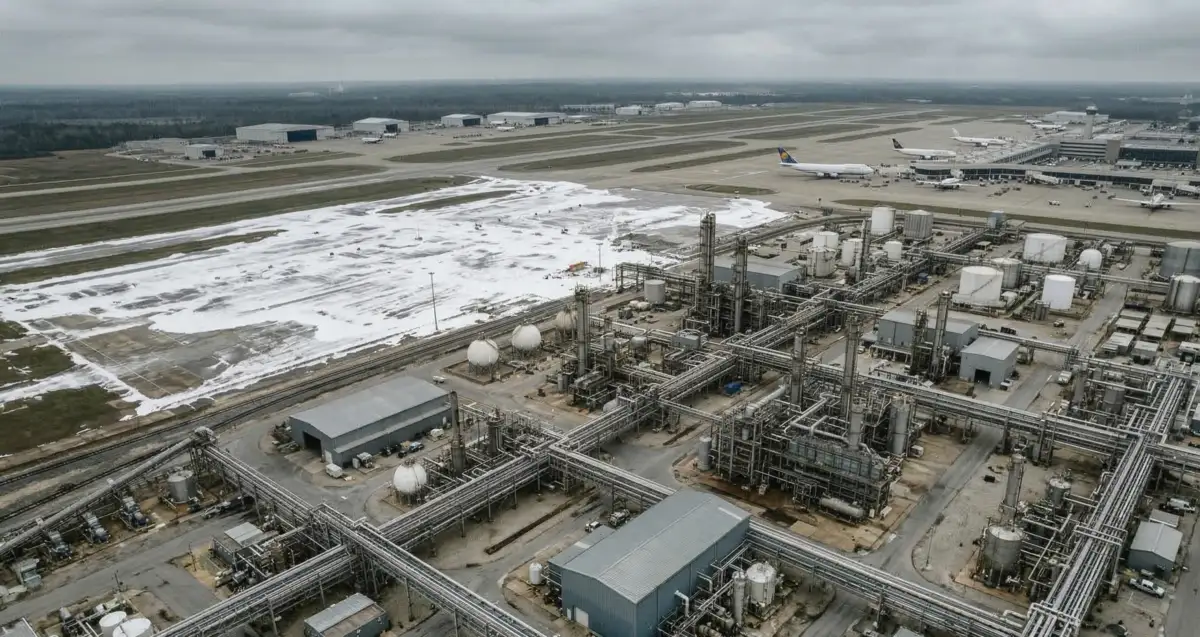
Aqueous film-forming foam (AFFF) has been the primary firefighting agent for fuel fires at military bases, airports, oil refineries, and fire training facilities since the 1970s. AFFF contains high concentrations of PFOS and other PFAS. Decades of use and disposal have contaminated groundwater near hundreds of military installations and civilian airports. The Department of Defense has identified over 700 installations with known or suspected PFAS contamination.
Industrial Manufacturing
Chemical plants, electronics manufacturers, semiconductor fabricators, textile mills, and chrome plating facilities use or produce PFAS. Industrial discharge — both permitted and unpermitted — introduces PFAS into surface water and wastewater systems.
Wastewater Treatment Plants
Conventional wastewater treatment does not remove PFAS. Treatment plants receive PFAS from residential, commercial, and industrial sources, and their treated effluent carries these chemicals downstream. Communities drawing drinking water from rivers that receive upstream wastewater discharge are particularly exposed.
Landfill Leachate
Consumer products containing PFAS — including food packaging, clothing, carpets, and cosmetics — end up in landfills. As they break down, PFAS leach into groundwater. Landfills near vulnerable aquifers pose a long-term contamination risk.
Biosolids and Agricultural Application
Treated sewage sludge (biosolids) spread on farmland as fertilizer can introduce PFAS into soil and, eventually, groundwater and well water. Several states have documented PFAS contamination in farming communities linked to biosolid application.
How Widespread Is PFAS Contamination?
PFAS contamination is not rare or localized — it is a national issue. Key data points:
- USGS (2023): A United States Geological Survey study sampling tap water from 716 locations found PFAS in an estimated 45% of U.S. tap water. Contamination was highest near urban areas, military bases, and wastewater treatment plants.
- UCMR 5 (2023-2025): The EPA’s Fifth Unregulated Contaminant Monitoring Rule required large public water systems to test for 29 PFAS compounds. See our UCMR 5 PFAS monitoring results coverage for the full breakdown — early results show widespread low-level detections across the country, with concentrations above the new MCLs in an estimated 6-10% of systems tested.
- State-level data: States with significant military presence (California, Virginia, North Carolina), industrial history (Michigan, New Jersey, Minnesota), or vulnerable groundwater (New Hampshire, Vermont) tend to show the highest contamination rates.
- Private wells: An estimated 20 million Americans on private wells near contamination sources may be exposed to PFAS with no monitoring or notification. Private wells are not covered by federal drinking water regulations — see our private wells and PFAS guide for testing and treatment guidance.
Search your city on WaterVerge to see whether PFAS have been detected in your local water system.
Health Effects
Research on PFAS health effects has accelerated dramatically in the past decade. While studies continue, the evidence base for several health outcomes is strong:
Cancer
The International Agency for Research on Cancer (IARC) classified PFOA as a Group 1 carcinogen (carcinogenic to humans) in 2023, based on sufficient evidence for kidney cancer and limited evidence for testicular cancer. PFOS was classified as Group 2B (possibly carcinogenic). Epidemiological studies of exposed communities — particularly around the DuPont Washington Works plant in West Virginia — have documented elevated rates of kidney, testicular, and bladder cancer.
Thyroid Disease
PFAS can disrupt thyroid hormone production. Multiple studies have linked PFAS exposure to hypothyroidism and altered thyroid hormone levels, particularly in women and children.
Immune System Suppression
PFAS exposure is associated with reduced antibody response to vaccines. Studies have shown that children with higher PFAS blood levels produce fewer antibodies after routine vaccinations, potentially reducing vaccine effectiveness.
Reproductive and Developmental Effects
PFAS exposure has been linked to reduced fertility, pregnancy-induced hypertension (preeclampsia), low birth weight, and altered fetal development. These effects are particularly concerning because PFAS cross the placental barrier and are present in breast milk.
Cholesterol and Metabolic Effects
Even at low concentrations, PFAS exposure is consistently associated with elevated total cholesterol and LDL cholesterol. Some studies also link PFAS to increased risk of metabolic syndrome and liver damage.
EPA PFAS Regulations (2024-2026)
The regulatory landscape for PFAS in drinking water has evolved rapidly and remains in flux.
April 2024: First National PFAS Standard
In April 2024, the Biden EPA finalized the first-ever national drinking water standard for PFAS, setting legally enforceable maximum contaminant levels (MCLs) for six compounds. This was a landmark rule — prior to this, there were no federal limits on PFAS in drinking water.
May 2025: Trump EPA Changes
In May 2025, the Trump administration’s EPA announced plans to revisit the April 2024 rule. The agency proposed extending compliance timelines and reevaluating the scientific basis for the MCLs, particularly for the Hazard Index approach used for PFAS mixtures.
January 2026: D.C. Circuit Ruling
In January 2026, the D.C. Circuit Court of Appeals upheld the core of the April 2024 rule, ruling that the EPA had acted within its authority and that the scientific evidence supported the MCLs. The court did allow minor adjustments to compliance timelines but rejected the broader effort to roll back the standards.
Current Status
As of March 2026, the six individual MCLs from the April 2024 rule are in effect. Public water systems must begin initial monitoring by 2027 and achieve full compliance between 2029 and 2031, depending on system size and the complexity of required treatment upgrades. The EPA estimates compliance costs of $1.5 billion per year but projects that the rule will prevent thousands of cancers and other serious illnesses.
The 6 Regulated Compounds
| Compound | Type | MCL | Notes |
|---|---|---|---|
| PFOA | Individual | 4.0 ppt | Group 1 carcinogen (IARC). Legacy compound from Teflon manufacturing. |
| PFOS | Individual | 4.0 ppt | Legacy compound from Scotchgard and AFFF. Most commonly detected in water. |
| HFPO-DA (GenX) | Individual | 10 ppt | Short-chain replacement for PFOA. Produced by Chemours. |
| PFHxS | Hazard Index | HI of 1.0 | Used in firefighting foam and metal plating. |
| PFNA | Hazard Index | HI of 1.0 | Found in food packaging and industrial emissions. |
| PFBS | Hazard Index | HI of 1.0 | Short-chain compound with long half-life in water. |
For the last three compounds (PFHxS, PFNA, PFBS), the EPA uses a Hazard Index approach rather than individual MCLs. The Hazard Index sums the ratios of each compound’s detected level to its health-based reference value. If the sum exceeds 1.0, the system is in violation. This approach accounts for the combined health effects of PFAS mixtures.
The MCL of 4 parts per trillion (ppt) for PFOA and PFOS is extraordinarily low — it’s roughly equivalent to four drops of water in an Olympic-sized swimming pool. Achieving these levels requires advanced treatment technology at many systems.
How to Check Your Water for PFAS
WaterVerge PFAS Tracker
Search your city on WaterVerge to see PFAS detection data compiled from UCMR 5 monitoring, state-level testing, and EPA databases. We show which specific compounds were detected, at what concentrations, and how they compare to the new federal MCLs.
Your CCR
Newer Consumer Confidence Reports may include PFAS testing results, particularly if your system participated in UCMR 5 monitoring. However, many smaller systems haven’t tested for PFAS yet and won’t be required to until 2027. See our guide to reading your CCR for help interpreting the data.
UCMR 5 Data
The EPA’s Fifth Unregulated Contaminant Monitoring Rule required all large systems (serving 10,000+) and a representative sample of small systems to test for 29 PFAS compounds between 2023 and 2025. Results are publicly available on the EPA’s UCMR website.
Home Testing
If you want to test your own tap water (or if you’re on a private well), certified PFAS testing is available through:
- Eurofins Scientific: Full PFAS panel, $195-$300
- SimpleLab (Tap Score): PFAS add-on to standard testing, ~$250
- State health departments: Some states offer free or subsidized PFAS testing in known contamination zones. Check your state’s environmental agency website.
Home PFAS tests require certified EPA Method 533 or 537.1 laboratories. Results typically take 2-4 weeks.
Removing PFAS from Drinking Water
Not all filtration technologies are effective against PFAS. Here’s what the research shows:
Reverse Osmosis (RO)
The most effective home treatment for PFAS — see our best reverse osmosis systems for tested picks. Residential RO systems push water through a semipermeable membrane with pores small enough to reject PFAS molecules. Studies consistently show greater than 90% removal of both long-chain and short-chain PFAS.
- Typical cost: $150-$400 for under-sink systems
- Maintenance: Membrane replacement every 2-3 years; pre/post filters every 6-12 months
- Drawback: Produces wastewater (typically 2-4 gallons of waste per gallon of filtered water)
Granular Activated Carbon (GAC)
The most studied PFAS treatment technology at the utility scale. GAC adsorbs PFAS molecules onto the carbon surface. It’s most effective for longer-chain PFAS (PFOA, PFOS) with removal rates of 60-90%, but less effective for short-chain compounds (GenX, PFBS) that break through the carbon bed more quickly.
- Typical cost: $50-$200 for under-sink carbon block filters; utility-scale GAC systems cost millions
- Key factor: Carbon must be replaced regularly — exhausted carbon stops adsorbing PFAS
Ion Exchange (IX)
Specialized ion exchange resins designed for PFAS can achieve the highest initial removal rates — often exceeding 95% for both long-chain and short-chain compounds. However, performance degrades over time as the resin becomes saturated, and regeneration can be complex.
- Typical cost: $1,000+ for whole-house systems
- Best for: Utility-scale treatment and whole-house systems in high-contamination areas
NSF P473 Pitcher Filters
Several pitcher filters have been independently tested and/or certified for PFAS reduction (see our best water filter pitchers and best under-sink water filters guides for full reviews):
- Clearly Filtered: Tested to remove 99.9% of PFOA and PFOS
- Epic Pure: Independent Eurofins testing shows PFAS removal to below detection limits
- Brita Elite: Some PFAS reduction capability, but not P473 certified
- ZeroWater: Removes PFAS as part of total TDS reduction, but filter life is short
Standard Brita filters (white cartridge) and basic carbon faucet filters do not adequately remove PFAS. Look for NSF P473 certification or published independent lab reports.
What Doesn’t Work
Boiling water does not remove PFAS — it actually concentrates them by evaporating water while PFAS remain behind. Standard carbon faucet filters, basic pitcher filters without P473 certification, and water softeners provide minimal to no PFAS removal.
Reducing Broader PFAS Exposure
Drinking water is a significant PFAS exposure pathway, but it’s not the only one. To reduce total exposure:
- Cookware: Avoid nonstick pans marketed as “PTFE-coated” or “Teflon.” Choose stainless steel, cast iron, or ceramic. Note that newer “PFOA-free” nonstick coatings may still use other PFAS compounds.
- Food packaging: Microwave popcorn bags, fast-food wrappers, pizza boxes, and takeout containers often contain PFAS as grease-resistant coatings. Choose uncoated alternatives when possible.
- Stain-resistant treatments: Decline Scotchgard-type treatments on furniture, carpets, and clothing. Look for products labeled “PFAS-free.”
- Cosmetics and personal care: Some waterproof mascaras, foundations, sunscreens, and dental floss contain PFAS. Check product labels or databases like the EWG’s Skin Deep.
- Clothing: Some outdoor and athletic wear uses PFAS-based durable water repellent (DWR) coatings. Brands like Patagonia and Gore-Tex have committed to phasing out PFAS by 2025-2027.
Frequently Asked Questions
How do I know if my water has PFAS?
Search your city on WaterVerge to check UCMR 5 results and state-level PFAS data. If you’re on a private well or want tap-specific results, order a certified test from Eurofins or SimpleLab ($195-$300).
Does boiling water remove PFAS?
No. Boiling concentrates PFAS by evaporating pure water while the chemicals remain. Use an RO system or NSF P473-certified filter instead.
Are short-chain PFAS safer than long-chain?
Not necessarily. Short-chain PFAS (like GenX, PFBS) were introduced as replacements for PFOA and PFOS, but emerging research suggests they carry similar health risks. They also tend to be more mobile in groundwater and harder to filter, which is why the EPA included them in the 2024 rule.
Will my utility remove PFAS before the 2029 deadline?
It depends on your system’s size, contamination level, and available funding. The EPA estimates 6-10% of systems will need treatment upgrades. Systems serving over 10,000 people must begin monitoring by 2027 and achieve compliance by 2029. Smaller systems have until 2031. Check with your utility or monitor progress on WaterVerge.
What level of PFAS is safe?
The EPA set the MCLs for PFOA and PFOS at 4 parts per trillion — the lowest level that can be reliably measured. The MCLGs for both are zero, meaning the EPA considers no level of exposure risk-free. The practical goal is to reduce exposure as much as feasible through a combination of water treatment and reduced consumer product exposure.
Check your water quality
See what contaminants are in your city's tap water and get personalized filter recommendations.